

How Small Business Owners Can Reduce Taxes Legally
Most business owners assume paying high taxes is simply part of running a successful business.
It isn't.
While every business has a responsibility to pay taxes, many owners end up paying more than necessary simply because they don't know what opportunities are available to them. Others hear about tax-saving strategies but never use them because they seem too complicated, expensive, or risky.
The truth is that many tax-saving opportunities are already written into the tax code. The challenge isn't whether they exist. It's knowing which ones apply to your business and keeping the documentation needed to use them correctly.
In this article, you'll learn why so many entrepreneurs overpay in taxes, how proper bookkeeping lays the foundation for smarter tax planning, and several legal tax strategies that may be worth discussing with your CPA or tax advisor.
Why Many Small Business Owners Pay More Taxes Than They Need To
Most business owners work with a CPA to prepare and file their taxes.
That's important.
But preparing a tax return and proactively planning to reduce taxes aren't always the same thing.
Many entrepreneurs receive excellent compliance support while missing opportunities that require additional planning or documentation throughout the year.
Without organized financial records, it's difficult to identify tax-saving opportunities before it's too late.
That's why bookkeeping and tax planning go hand in hand.
Bookkeeping Comes Before Tax Strategy
Before you think about advanced tax planning, your financial records need to be accurate and current.
Bookkeeping provides the information needed to understand:
Revenue
Expenses
Cash flow
Profitability
Business spending
Financial trends
Without that foundation, it's difficult to know whether you're making the best financial decisions or taking advantage of available tax opportunities.
What Is a Bookkeeping Virtual Assistant?
A bookkeeping virtual assistant is a remote bookkeeping professional who helps maintain accurate financial records, categorize transactions, reconcile accounts, and prepare financial reports.
By keeping books updated consistently, business owners can spend more time making strategic decisions instead of organizing receipts or catching up before tax season.

Tax Planning Isn't Just About Write-Offs
Many entrepreneurs think tax savings begin and end with deducting business expenses.
While deductions certainly matter, tax planning often includes additional strategies that go beyond simply tracking purchases.
Some tax strategies focus on:
Business structure
Family employment
Meeting documentation
Retirement planning
Proper recordkeeping
Compliance requirements
Each strategy has its own rules and qualifications, making professional guidance essential.
Tax Strategy Spotlight: The Augusta Rule
A tax strategy often missed by business owners is known as the Augusta rule.
In general terms, this rule may allow qualifying business owners to hold legitimate business meetings at their residence under specific IRS guidelines.
Like any tax strategy, proper documentation and compliance are essential.
Potential benefits may include:
Additional business deductions
Better documentation of business activities
More structured business operations
If you're interested in this strategy, it's important to discuss whether it applies to your specific situation with your CPA or tax professional.
Tax Strategy Spotlight: Employing Family Members
Some business owners involve their children in legitimate business activities.
Examples might include:
Helping with social media
Modeling for marketing materials
Office organization
Administrative work
Filing documents
When structured correctly and compensated at reasonable market rates, family employment can create tax advantages while teaching valuable business skills.
The key is ensuring:
The work is legitimate.
Compensation is reasonable.
Documentation is complete.
IRS requirements are followed.
Why Documentation Matters
Many valuable tax strategies aren't necessarily difficult.
They're documentation-intensive.
For example, certain strategies may require:
Written agreements
Fair market value documentation
Meeting records
Payroll records
Supporting documentation
Without proper paperwork, otherwise legitimate tax strategies may not withstand scrutiny.
That's one reason automation tools have become increasingly valuable for business owners.
How Automation Is Changing Tax Planning
Years ago, business owners often delivered a shoebox full of receipts to their accountant.
Today, bookkeeping software automatically captures transactions, organizes receipts, and simplifies recordkeeping.
Tax planning is following a similar path.
Modern automation tools can help organize documentation required for certain tax strategies, reducing manual paperwork while helping business owners stay organized.
Automation doesn't replace professional advice.
It simply makes following the required process easier.
Why Separating Personal and Business Finances Matters
Mixing personal and business expenses creates more than bookkeeping headaches.
It can also:
Complicate tax preparation
Make deductions harder to document
Create inaccurate financial reports
Reduce confidence in financial decisions
Treating your business as a separate financial entity leads to cleaner records and stronger financial management.

Better Financial Visibility Leads to Better Decisions
Once bookkeeping is current, many business owners discover opportunities they didn't know existed.
They may realize:
Prices need to increase.
Software subscriptions are being wasted.
Certain services aren't profitable.
Cash flow needs improvement.
Profit margins are lower than expected.
Accurate financial reports transform bookkeeping from an administrative task into a decision-making tool.
Compliance Creates Confidence
Many entrepreneurs feel overwhelmed by taxes because they worry about making mistakes.
The solution isn't avoiding financial management.
It's building systems that make compliance easier.
That includes:
Organized bookkeeping
Consistent financial reviews
Proper documentation
Working with qualified professionals
Reviewing tax strategies throughout the year
When everything is organized, financial decisions become much less stressful.
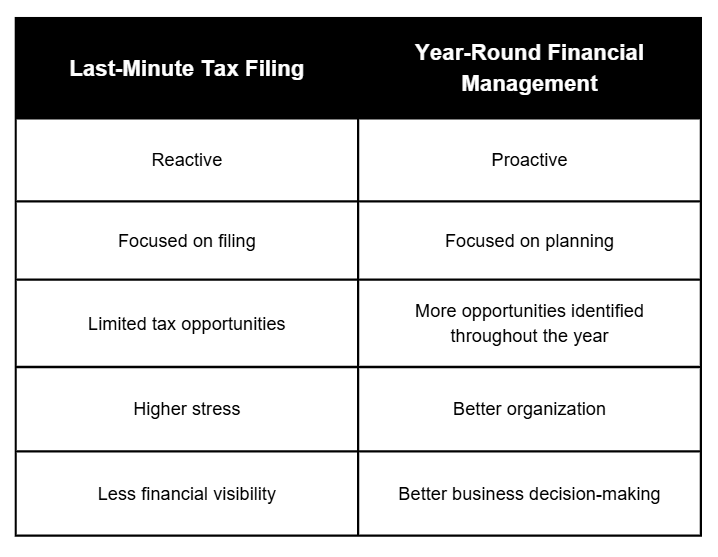
DIY Tax Planning vs Year-Round Financial Management
Common Mistakes
1. Waiting Until Tax Season
Tax planning works best when it's part of your business throughout the year.
2. Treating Bookkeeping as a Once-a-Year Task
Current financial records make planning significantly easier.
3. Mixing Personal and Business Transactions
Separate finances improve bookkeeping, reporting, and documentation.
4. Assuming Every Tax Strategy Applies to Every Business
Different businesses qualify for different opportunities.
Professional guidance matters.
5. Ignoring Documentation
Even legitimate tax strategies require proper records.
Without documentation, opportunities may be lost.
Frequently Asked Questions
Why do many small business owners overpay taxes?
Many business owners focus on filing taxes correctly but don't spend enough time planning throughout the year. Without organized bookkeeping and proactive financial reviews, opportunities to reduce taxes legally may be overlooked.
What is tax planning?
Tax planning is the process of organizing your finances throughout the year to legally reduce taxes while remaining compliant with tax laws. It often involves bookkeeping, financial planning, business structure decisions, and documentation.
Is bookkeeping necessary for tax planning?
Yes. Accurate bookkeeping provides the financial information needed to identify tax-saving opportunities and support any deductions or strategies you choose to use.
What is the Augusta Rule?
The Augusta Rule is a tax provision that may allow qualifying business owners to rent their home for certain business meetings under specific IRS rules. Because eligibility depends on individual circumstances, business owners should consult their tax professional before using this strategy.
Can I hire my children to work in my business?
Possibly. If the work is legitimate, compensation is reasonable, and all applicable tax rules are followed, family employment may provide both business and tax benefits. Professional guidance is recommended.
Why is documentation so important?
Many tax strategies depend on maintaining proper records. Documentation demonstrates that business activities were legitimate and helps support tax positions if questions arise later.
Does automation replace a CPA?
No. Automation can simplify paperwork and organization, but it doesn't replace professional tax or legal advice. Business owners should continue working with qualified professionals when making tax decisions.
When should I start tax planning?
Ideally, tax planning should happen throughout the year. Waiting until tax season limits your options and often increases stress.
Questions This Article Answers
How can small business owners reduce taxes legally?
Why do entrepreneurs overpay taxes?
What is tax planning?
Why is bookkeeping important for taxes?
What is the Augusta Rule?
Can I legally pay my children through my business?
Why should I separate personal and business finances?
How does automation help tax planning?
What's the difference between tax preparation and tax planning?
How can I organize my finances better?
Why does documentation matter for tax strategies?
When should tax planning begin?
What role does bookkeeping play in profitability?
How can compliance protect my business?
What financial reports should business owners review?
Conclusion
Reducing your tax bill legally doesn't start with finding a hidden loophole.
It starts with understanding your business.
When your bookkeeping is accurate, your financial records are organized, and you're reviewing your numbers consistently, you put yourself in a position to make smarter decisions throughout the year.
From there, you can work with trusted professionals to determine which tax strategies fit your business and how to document them properly.
The goal isn't to avoid paying taxes. It's to avoid paying more than you legally owe while building a stronger, healthier, and more profitable business.
Key Takeaways
Many small business owners overpay taxes because they aren't aware of available tax strategies.
Good bookkeeping is the foundation for effective tax planning.
Some tax-saving opportunities require documentation more than they require complexity.
Running your business like a business improves both financial organization and legal protection.
Tax planning should happen throughout the year, not just before filing your return.